

Restore Missing Teeth With a Stable, Natural-Looking Solution
A fixed dental bridge is designed to replace one or more missing teeth by using nearby teeth or dental implants for support. Unlike removable partial dentures, a fixed bridge stays securely in place and is custom-made to restore your smile, improve chewing, and help keep surrounding teeth from shifting.
At Southern Laser Dentistry, we take a careful, personalized approach to tooth replacement. Our doctors evaluate your bite, gum health, bone support, remaining teeth, and long-term goals before recommending whether a fixed bridge is the right option for you.
You May Be a Candidate for a Fixed bridge If you...

You are missing one or more teeth
A bridge can close visible gaps and restore your smile.

You are unhappy with gaps in your smile
A bridge can improve the appearance of missing teeth.

You want a non-removable tooth replacement option
A fixed bridge stays in place and does not need to be removed daily.

You avoid chewing on one side
Missing teeth can make chewing uncomfortable or uneven.

Your surrounding teeth are healthy enough for support
Strong neighboring teeth may be able to anchor a fixed bridge.

You may not be ready for a dental implant
A bridge may be an alternative when implants are not preferred or not immediately possible.
Why Replacing Missing
Teeth Matters
Missing teeth are more than a cosmetic issue. When a tooth is lost, the surrounding teeth can begin to shift into the open space. This may affect your bite, chewing pattern, speech, jaw comfort, and long-term dental stability.
Replacing missing teeth can help:
-
Improve chewing function
-
Support clearer speech
-
Reduce shifting of neighboring teeth
-
Improve smile appearance
-
Support facial balance
-
Distribute bite pressure more evenly
-
Protect remaining teeth from unnecessary strain
The longer a missing tooth space is left untreated, the more complicated the treatment may become.
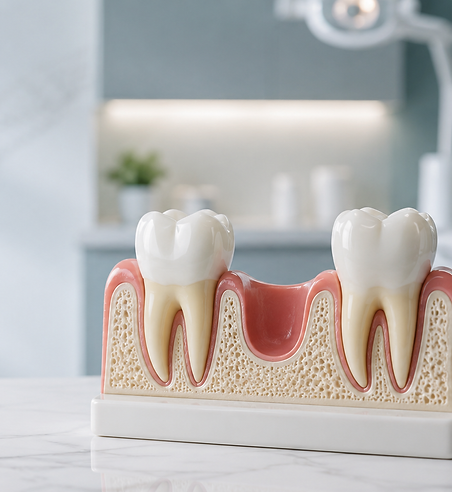
Types of Dental Bridges

Traditional Fixed Bridge
A traditional bridge is supported by the natural teeth on each side of the missing tooth space. These supporting teeth are shaped and covered with crowns that hold the replacement tooth in place.
This option may work well when the neighboring teeth already need crowns or have larger restorations.

Cantilever Bridge
A cantilever bridge is supported on only one side of the missing tooth space.
This is used less often and only in specific cases where the bite forces are appropriate.

Implant-Supported Bridge
An implant-supported bridge is attached to dental implants rather than natural teeth. This option may be recommended when multiple teeth are missing or when using natural teeth for support is not ideal.
Implant-supported bridges can offer excellent stability and may help preserve nearby natural tooth structure.

Maryland Bridge
A Maryland bridge uses a bonded framework behind the neighboring teeth instead of full crowns.
This option may be considered in select situations, often for front teeth, but it is not ideal for every bite.
Fixed Bridge vs. Dental Implant
Both fixed bridges and dental implants can replace missing teeth, but they are not the same treatment.

-
Uses nearby teeth or implants for support
-
May be completed faster in some cases
-
May require reshaping nearby teeth
-
Can replace one or multiple teeth
-
May be a good option if neighboring teeth need crowns
Fixed Bridge

-
Replaces the tooth root with an implant
-
Often requires more healing time
-
Does not usually require altering neighboring teeth
-
Can replace one tooth or support larger restorations
-
May be ideal when surrounding teeth are healthy
Dental Implant
There is no one-size-fits-all answer. The best option depends on your oral health, bone support, bite, budget, timeline, and long-term goals.
Our Fixed Bridge Process

1
Evaluate Your Teeth, Gums, and Bite
Your visit begins with a detailed exam of the missing tooth area, nearby teeth, gum health, bite, and overall oral health. Digital imaging or Cone Beam CT imaging may be recommended when more detail is needed.
2
Plan the Right Replacement Option
We review whether a fixed bridge, dental implant, partial denture, or another option makes the most sense for your needs. If a bridge is recommended, we explain the type of bridge, supporting teeth, timeline, and next steps clearly.
For a traditional bridge, the supporting teeth are prepared and a temporary bridge may be placed while your final restoration is made. Once ready, we check the fit, bite, shape, and comfort before securing your custom bridge. We also show you how to clean and maintain it properly.
Prepare, Place, and Protect Your Bridge
3

Fixed Bridges and Same-Day Crown Technology
Southern Laser Dentistry offers advanced restorative technology, including same-day crown capabilities in select cases.
Some bridge cases require lab fabrication for the best strength, fit, and esthetics. During your consultation, we will explain whether your bridge can be completed in-office or should be made through a dental lab.
The priority is accuracy, durability, and long-term function — not rushing the process.
Fixed Bridges May be Recommended With Other Services
Depending on your needs, your treatment plan may include:


Fixed Bridge FAQs
Still have questions? Our team is here to help you feel confident before your visit.
Ready to Talk About Replacing a Missing Tooth?
If you are missing one or more teeth, a fixed dental bridge may help restore your smile, chewing ability, and confidence.
At Southern Laser Dentistry, we will evaluate your full oral health picture and help you compare your options clearly, including fixed bridges, dental implants, and partial dentures.
